Pearson Edexcel · A-Level · Mathematics
Course version: 9MA0 · Version from Mar 2026
Understand and use the coordinate geometry of the circle including using…
Full specification wording
Coordinate geometry in the (x, y) plane: 3.2 Understand and use the coordinate geometry of the circle including using the equation of a circle in the form (x − a)² + (y − b)² = r²; completing the square to find the centre and radius of a circle; use of the following properties: the angle in a semicircle is a right angle; the perpendicular from the centre to a chord bisects the chord; the radius of a circle at a given point on its circumference is perpendicular to the tangent to the circle at that point.
A circle with centre (a, b) and radius r has equation (x − a)² + (y − b)² = r², so (x − 3)² + (y + 1)² = 25 has centre (3, −1) and radius 5.
Checked against the Pearson Edexcel 9MA0 specification (opens in a new tab) on .
- Point 2 of 4
- 4 key terms
Study notes
From the checked teaching notes for this specification point.
The idea
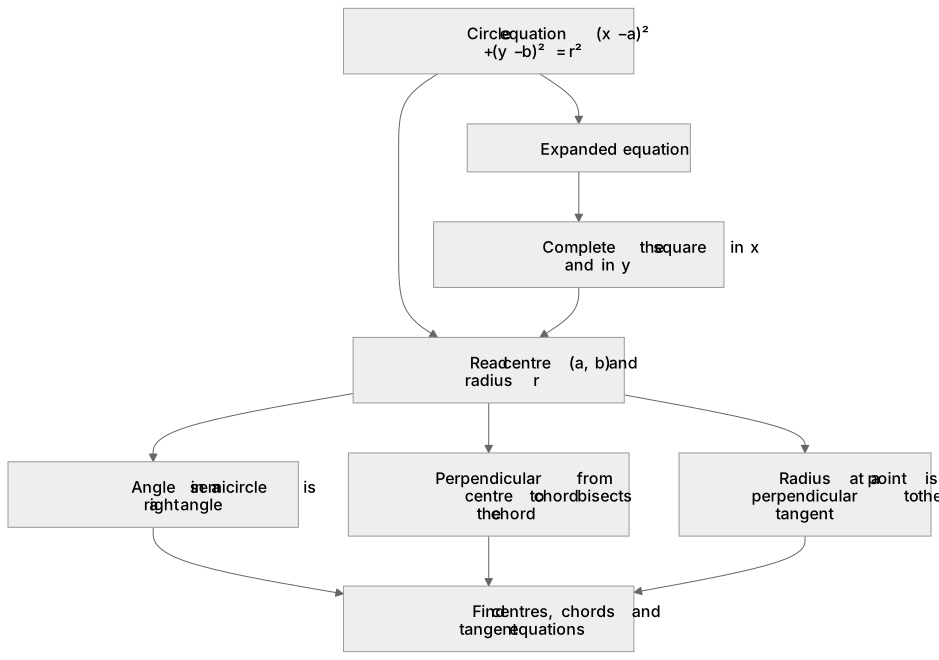
A circle with centre (a, b) and radius r has equation (x − a)² + (y − b)² = r², so (x − 3)² + (y + 1)² = 25 has centre (3, −1) and radius 5. If the equation is expanded, such as x² + y² − 6x + 2y − 15 = 0, complete the square in x and in y to recover the centre and radius. Three circle theorems support coordinate work: the angle in a semicircle is a right angle, so a triangle with a diameter as one side has a right angle at the circumference; the perpendicular from the centre to a chord bisects the chord; and the radius at a point on the circumference is perpendicular to the tangent there. These let you find centres, chords and tangent equations.
What earns the marks
- Reads the centre and radius directly from (x − a)² + (y − b)² = r², taking care with the signs of a and b.
- Completes the square in both x and y to convert a general circle equation into centre-radius form.
- Uses the angle in a semicircle being a right angle to set up a perpendicular or right-angled triangle condition.
- Applies the perpendicular from the centre to a chord bisecting the chord to find a midpoint or a length.
- Uses the radius being perpendicular to the tangent to find a tangent gradient as the negative reciprocal of the radius gradient.
Common mistakes and how to put them right
Reading the centre as (a, b) without reversing signs.
Put it right: (x − 3)² gives x-coordinate 3.
Forgetting to subtract the constant when completing the square.
Put it right: Balance both sides so the equation becomes (x − a)² + (y − b)² = r².
Using the radius gradient itself as the tangent gradient.
Put it right: Take the negative reciprocal, since radius and tangent are perpendicular.
Exam tips
- Sketch the circle with its centre marked to avoid sign errors.
- When a chord or tangent is involved, draw the radius to the relevant point and mark the right angle.
- Check the radius by substituting a known point on the circle into the equation.
Try the lesson
The start of the Coordinate geometry in the (x, y) plane: 3.2 Understand and use the coordinate geometry of the circle including using the equation of a circle in the form (x − a)² + (y − b)² = r²; completing the square to find the centre and radius of a circle; use of the following properties: the angle in a semicircle is a right angle; the perpendicular from the centre to a chord bisects the chord; the radius of a circle at a given point on its circumference is perpendicular to the tangent to the circle at that point. lesson, made from checked teaching notes for this specification point.
Have a go first
A circle has equation (x − 4)² + (y + 3)² = 25. State the centre and radius of the circle.
Listen
A circle with centre (a, b) and radius r has equation (x − a)² + (y − b)² = r², so (x − 3)² + (y + 1)² = 25 has centre (3, −1) and radius 5. If the equation is expanded, such as x² + y² − 6x + 2y − 15 = 0, complete the square in x and in y to recover the centre and radius. Three circle theorems support coordinate work: the angle in a semicircle is a right angle, so a triangle with a diameter as one side has a right angle at the circumference; the perpendicular from the centre to a chord bisects the chord; and the radius at a point on the circumference is perpendicular to the tangent there. These let you find centres, chords and tangent equations. A strong answer earns marks for these points. Reads the centre and radius directly from (x − a)² + (y − b)² = r², taking care with the signs of a and b. Completes the square in both x and y to convert a general circle equation into centre-radius form. Uses the angle in a semicircle being a right angle to set up a perpendicular or right-angled triangle condition. Applies the perpendicular from the centre to a chord bisecting the chord to find a midpoint or a length. A common slip: Reading the centre as (a, b) without reversing signs: the error is taking (x − 3)² as centre (−3, b). Instead, (x − 3)² gives x-coordinate 3. Exam tip: Sketch the circle with its centre marked to avoid sign errors.
See it
Key words
Say what each word means before you turn the card.
Centre-radius form
Try answering aloud or in your head before turning the card.
Completing the square
Try answering aloud or in your head before turning the card.
Angle in a semicircle
Try answering aloud or in your head before turning the card.
Perpendicular from the centre to a chord
Try answering aloud or in your head before turning the card.
See every definition
- Centre-radius form
- The equation of a circle written as (x − a)² + (y − b)² = r², giving centre (a, b) and radius r.
- Completing the square
- Used in x and in y to convert a general circle equation into centre-radius form, recovering the centre and radius.
- Angle in a semicircle
- A right angle, so a triangle with a diameter as one side has a right angle at the circumference.
- Perpendicular from the centre to a chord
- It bisects the chord, which lets you find a midpoint or a length.
Label the diagram
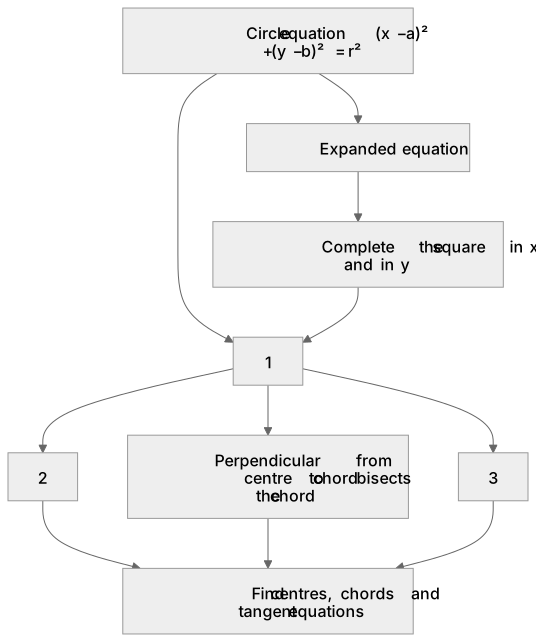
Some boxes have lost their names. Pick the right name for each number.
1Box 1
2Box 2
3Box 3
There is more to this lesson
The full lesson goes on to check your understanding and help you earn the marks. Create a free account to carry on, with your progress saved.
A week of Premium from your first lesson · Then the free plan continues · No card, no charge
Test your understanding of Coordinate geometry in the (x, y) plane: 3.2 Understand and use the coordinate geometry of the circle including using the equation of a circle in the form (x − a)² + (y − b)² = r²; completing the square to find the centre and radius of a circle; use of the following properties: the angle in a semicircle is a right angle; the perpendicular from the centre to a chord bisects the chord; the radius of a circle at a given point on its circumference is perpendicular to the tangent to the circle at that point.
Active recall beats re-reading. Take an instant quiz now to test what you’ve learned and lock it into long-term memory.
A week of Premium from your first lesson · Then the free plan continues · No card, no charge